January 28, 2012
In an effort toward transparency and to respond to a variety of faculty questions, I am posting a series on academic management, beginning with section management.
Every institution has a slightly different approach to determine what to schedule, when to schedule, and when to cancel, and when/how to assign. Some institutions make an offer guarantee. If they offer a class, it will make, even if there are only two students in it. These institutions mitigate the potential loss of revenue by offering fewer choices, which increases the likelihood that those classes will have sufficient numbers. Other institutions tend to offer more of a smorgasbord of classes, preferring to allow student choices to dictate what classes will be offered or canceled. The difficulty comes when an insufficient number of students choose to take a class or require for graduation. In theory, when this becomes systemic within a program, a program review is initiated with potential changes in curriculum or, if interventions don’t work, leads to complete removal of the program. In reality, institutions are usually too slow to react or fail to manage sections well. Too many instructional resources are directed at too few students with dire consequences for the entire institution.
So it’s only fitting that we be able to transparently address questions of how we manage sections. By knowing the decision-making process, faculty could be engaged in problem-solving in advance of scheduling to minimize the impact on students.
Recognizing that every Dean or VP approaches cancellations slightly differently, here’s my approach. First, one has to determine the section management goal. Is it to maximize revenue, minimize student and faculty pain, manage resources wisely, or something else? I believe that “healthy enrollments” are both financially and pedagogically most appropriate. This means I am equally disturbed by numbers that don’t make sense for learning as I am for numbers that don’t make sense financially. A traditional classroom with three students or 45 is equally problematic to learning. Financially, the calculation is actually pretty simple. We take the total revenue expenditures needed to teach a section divided by the class total gained by registrations for a class (tuition). To simplify things, we make some estimations. We use the full-time overload rate times the number of credit hours as the total cost, even though their additional cost to light the rooms keep building it supports student services activities that are targeted towards that class. And we may add a bit of a fudge factor. At Richland, the magic number based on the calculation is 10, which serves pretty well for estimating “health” which encompasses financial, pedagogical, and other factors. Some classes, such as clinicals are “healthy” at six and full at eight. But 10 serves us well. Once the magic number is determined, I ask deans began to manage in surgical fashion, canceling a few sections at a time in disparate areas and early, so that students can begin to migrate into other classes in effort to save sections in danger of cancellation. I call this “pruning trees” as reduction of some sections leads to growth elsewhere.
Cancellation presents it’s own problems. The potential difficulties to faculty and students when classes are canceled can be severe. Full-time faculty, who arguably are impacted the least, have planned their families and outside commitments around a schedule, but continue to receive their paychecks, even if they find that significant adjustments are necessary. Adjunct faculty who may have been counting on particular supplemental revenue stream they also face schedule changes and potentially not be able to teach for Richland that all. Finally and most important, students who are committed to graduation or to a work schedule or to their children are thrown into significant distress when the class they expect to take, and in many cases are required to take, is not offered. Delay of a semester or year or be catastrophic to the financial well-being of students intending to graduate and those who are looking for work related credentials experience lost pay. Cancellations also reduce students overall satisfaction towards the institution, with negative current consequences and alumni response. So pruning is but one solution. Limiting cancellations starts with forecasting: offering the right things at the right times — and not too many.
Deans have the opportunity to advocate for sections that may need to special consideration. Is the class required for graduation specifically? Is the class the only scheduled version of a particular course? If there are other sections of the course offered, are there sufficient seats in those other sections too, did the students? Is it and “special section” such as a night class that endangers students abilities to take it if canceled? What is the enrollment history of this course and time? Collaborating with faculty members, deans can try to identify solutions that would reduce the cost, such as stacking, teaching pro rata, or independent study, but these only impact immediate need, not overall health. Absent these “fixes,” if a section has less than 10 students in a course in which other sections are offered, and there are sufficient seats to accommodate the students in the low enrollment section elsewhere, the course will be canceled. If there are not other options of the specific class, but there are other IAI -related courses out there, the course might be cancelled and the dean and I should talk about those decisions. Finally, a “post-mortem” on those sections that were cancelled or required fixes must be initiated to feed into the next scheduling process.
All of this can be distilled into the sample section management scorecard (this would be part of a level 2 scorecard). The thresholds indicate that we would get really concerned if we end up canceling more than 15% of the sections, leave more than 50% seats in a section empty, offer too many sections with few students, or have too many low enrollment classes (average seat count). Remember the goals: healthy enrollment and fewer cancellations. The thresholds are oriented towards those goals.
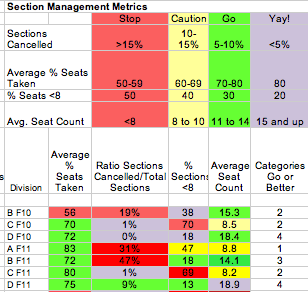
Looking at the section management scorecard sample it’s clear that, based on thresholds oriented towards “healthy”, we are doing pretty well. It’d be great to be able to fill 80% of the seats and to keep down the number of really low enrollments and cancelled classes and that’s the emphasis. It’s also clear that scorecards are meant to start conversations, not pass judgment. Division C, for example, is doing a terrific job, even though there are some yellows and reds. How do I know? Well, I’ll give you a hint — clinicals. Division C has seat maxes of 8 for many of it’s classes. So maybe we modify the thresholds, but most important, we talk. That said, a point of emphasis for all of our divisions the next several semesters will on reducing cancellations and low enrollment classes to reduce impacts on students satisfaction and learning.
The process I have just described is neither totally mathematical nor arbitrary. Most important, it’s not unpredictable. This is why I’m sharing this information with you. If you are a faculty member who teaches in a general discipline, such as math, science, humanities, social sciences, etc. in which multiple sections of a single course are offered, you can, like administration, predict probabilities that classes will be offered. You can also ask to be engaged with your dean on some of the decision making, particularly around modifications of curricula when single section required courses are chronically low. Many faculty already are involved, and, so long as that involvement is intended to better the program it’s good. Ultimately, however, student feet do the talking, and we need to be strategic and responsive to student interests.


Leave a comment