Getting under the hood of the Aspen Award.
All the media attention placed on the Aspen Institute’s Top 150 Colleges provides a good opportunity to get ‘under the hood’ and find out what the Aspen Award is all about.
The Aspen Award is clear in its effort to utilize recognition as a carrot to motivate colleges toward enhanced student attainment. Completion incorporates both the traditional community college mission of access and affordability and adds the 21st century mission of completion. For this reason, community colleges and policymakers alike have jumped on the kind of recognition that results from the Aspen award.
The Aspen award process adds a rather ingenious little wrinkle. By taking nationally available data, the Institute first identifies institutions deemed “eligible” for the award itself and then provides a framework around which data and process are submitted, site visits ensue, finalists are selected, and ultimately one college can stand atop the program and celebrate as the Aspen award winner. By recognizing the ‘Top 150’ without the need for colleges to do a lot of legwork, Aspen is recognizing nationwide progress toward the Completion Agenda even if colleges choose not to seek the top prize in round two of the competition.
A review of the criteria suggest that a high mix mix of transfer to career – technical programs has been generally unsuited for completion focused results such as the Aspen award rewards. Career technical programs are inherently oriented towards enhanced completion because they automatically adopt the kinds of principles that a number of organizations’s, such as Complete College America and the Lumina Foundation, have espoused to enhance completion. These include cohorts, defined sequences, reduced choice, scheduling for completion, a defined outcome, and alignment with careers and socioeconomic enhancement. In addition, many career technical programs utilize selective admissions either formally, as is the case with a number of allied health programs, or informally, due to an expectation that prerequisites that are inherently self-selecting (i.e. STEM) are required for admission.
In past iterations of the award, Tacoma Community College has not been deemed eligible. As it happens, Tacoma Community College has traditionally had much higher numbers of transfer students relative to career technical focused students. Transfer programs have traditionally not incorporated all of these completion focused principles instead relying upon broad student choice and general education/distribution requirements. Like most colleges, TCC has much higher career-technical completion rates than transfer completion rates.
Advocates of guided pathways are quick to point out that transfer programs adopting these principles can mirror these completion results but that is topic for different blog.
In 2015, Tacoma Community College was deemed eligible for the Aspen award, making it purportedly among the top 150 colleges in the country. The enthusiastic response by community members, the media, and administration was vocal and expected.
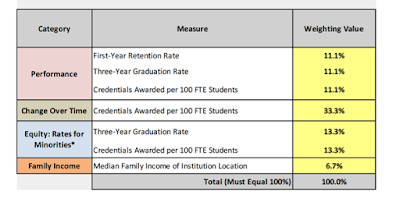
The reality of the Aspen award is that it takes a single all-encompassing metric, completion per 100 FTE, and aggregates it according to independent variables that relate to the community college equity agenda (proxy for access and affordability). The Aspen award then creates three “new” measures) from which it determines and institutions eligibility. These measures are overall completion, completion as analyzed through the lens of the achievement gap, and improvement of its overall completion rate. Because each of these three measures is ultimately about completion per 100 FTE, the Aspen award is intending to focus colleges on what matters — completion with equity.
Once an institution understands what it is being measured on, it is in a position to assess its own performance and the rationale for inclusion as “eligible.” The chart below indicates by color the distribution of data of the 2017 eligible institutions by category (green = top third, yellow = middle third, red = bottom third). The graphic below further sorts colleges by the frequency with which they are in the top third of the top 150. Eligible Washington colleges are also included and TCC is in orange. Lake Area Technical College (in purple) was a finalist in the 2015 Aspen Prize and can be considered a high performing benchmark.
Some colleges are eligible because their results are significantly better than the Average of all Community Colleges and some are eligible because they have improved a lot in the past five years. Improvement is 33% of the total weighting which gives improving colleges an opportunity to be recognized. Tacoma Community College clearly falls into this category.
Winning the Aspen Prize itself, however, is another matter and top performers have parlayed improvement into results. All of the colleges who are in the top 1/3 of four or more metrics can boast that they retain and complete students at a high level across programs AND have bridged the achievement gap. Completion does matter, these colleges get it…and so does Aspen.

The unmistakable conclusion for TCC, however, is somewhat different. TCC has gained eligibility by our improvement over time and that improvement over time all goes back to Credentials Awarded per 100 FTE with double credit given to Associate’s degrees. We have bridged the achievement gap but we are not increasing completion overall. TCC has much room for growth on this, particularly in the transfer area. The picture is similar for other Washington colleges, with the notable exception of Renton Technical College (and one assumes the 2013 Aspen Winner, Walla Walla).
Building pathways in transfer areas offers much promise for us all, but time will tell. In the meantime, we all have continued work to do for our communities and students.


Leave a comment