Sunday, April 3, 2016
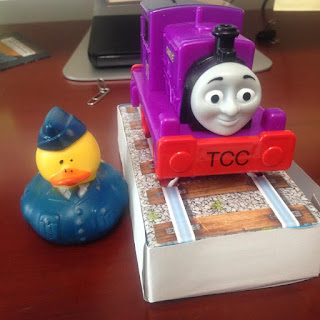
My institution’s focus on completion for transfer students includes development of what we originally called transfer certificates. But since transfer certificates aren’t officially recognized by our state, we had to come up with a new name that would make sense. Words were thrown about – concentrations, minors, foci, pathways, distinctions. Absent clear agreement on what to call them, the faculty temporarily referred to them as ducks before settling on distinction pathways…
Desiring to keep the development of ducks local, small groups of faculty engaged in their respective “duck quacking” – sustainability, honors, ethnic and gender studies – each of the ducks represents an opportunity for student to explore in some depth a topic of potential interest.
The work is meaningful in multiple ways. First, the faculty are excited to explore the opportunity for new program development, particularly when the development allows them a chance to further develop a topic that they themselves are interested in. Second, if developed correctly, ducks can provide a student with demonstrated expertise that can help them advance whatever their interest might be, whether employability, greater competitiveness upon transfer, or enhanced confidence due to the fact that they have developed something unique for themselves. Finally, ducks advance an institutional interest to enhance transfer completion by moving students ‘up the tree’ and into a career cluster of interest.
Eager to implement what they have so diligently conceptualized, each faculty group has been in a bit of a race to implement, much to the chagrin of both the curriculum committee chair and enrollment services, both of whom have significant concerns about the ability to implement with quality, implement with equity, and recognize completers in such a way that is both efficient and effective in helping them demonstrate to others. Given these competing interests, I felt the need to request a meeting with all these disparate groups hoping to seek alignment and to create somewhat of a planning path that sequence the necessary steps for implementation.
As the meeting commenced it became clear that some faculty were frustrated because they felt that administration was slowing them down. Enrollment services was frustrated because they felt like it was going too fast and they had not been kept in the loop. Curriculum committee was frustrated that while a great deal of learning was going on with the faculty on the committee, everyone was pushing a quick resolution. I listened. It was then that it hit me – we weren’t talking about ducks at all but about trains, and as an academic vice president, my job to ensure that the trains run on time and that as they reach each station those at the station are ready to jump on. As my imagination began to wander I thought of Thomas the Tank Engine. I saw the crashing of steam engines, signal lights, crashes, and…conductors.
The most important stop in any program development is the first station, getting the right faculty on the train so that the program’s curriculum and intention actually mean something to students. Having an assessment person on that stop is extremely helpful. In addition to ensuring that the program learning outcomes mean something, the faculty at this stage need to identify some data that supports that student interest can generate reasonable enrollments and the student completion can generate some benefit. This could be in the form of articulation agreements in parentheses scratch that scratch that articulation potential, job statistics, or even news articles conveying critical skills shortages in the service area that can be met by the program.
I was surprised to learn the extent to which the faculty were getting off track and wandering around. This is not a problem, but a symptom of their enthusiasm. Rather than moving the train to the next critical station –department chairs and deans — faculty sometimes overstay their stop at the conceptualizing station. It may seem obvious, but chairs and deans can provide the kinds of logistic, resource, framing advice that can help advance the program. More important, failure to bring deans and chairs into the design phase fatal conflicts, or delaying prioritization difficulties, or getting stuck on a dead-end track.
The curriculum committee station didn’t really exist for programs at my institution. One by one the lightbulbs began to go off in the room as we all collectively realized that we are building simultaneously the frameworks, system, and products of something very grand that will help our students. The curriculum committee is very accustomed to analyzing courses to assess course and program learning outcomes, assessment methods, activities and content, etc., but had never really considered what the criteria should be to determine that a program actually should move past their station. Issues like ensuring that program learning outcomes provide sufficient value, needs assessment warrants institutional investment, and that the pathway supports student completion are all relatively new considerations. But here’s the kicker, when faculty do become accustomed to assessing these key considerations, faculty themselves are in the best position to guide, support, or even redirect their colleagues to advance the institutional curriculum.
The station everybody seems to forget about – enrollment services – is literally the place where the metal hits the rail because no program implementation can be successful if you can’t identify the students participating, audit their advancement to completion, and document unofficial transcript that they have. The appreciation they shared to be included at the beginning of rail building will do much to ensure that, when the train does reach their station, all will be smooth.
Next stop: Students!
One of the presidents I have worked for liked to refer to herself as the conductor. She was a music major and the metaphor was astute as she tried to identify ‘first chairs’ in the percussion, wind, brass, and string sections. As chief academic officer, I’m a conductor too, but my job is to build track and stations and make sure the trains are on time: not too slow, not too fast, but just right. Together, we are all very useful engines!


Leave a comment