
An amoeba is a useful metaphor for team leadership. An amoeba is a single celled organism that operates autonomously but with individual pseudopods that reach out on their own to explore, discover, and ingest. When a food source has been ingested, the amoeba breaks it down to components and utilizes it for its own purposes. Always, the pseudo-pod remains connected to the body for purposes of feeding the body. Team leadership feeds on knowledge in largely the same way. Individual leaders serve the team. The team operates as a single organism.
I have been blessed to work with several such teams. Each was developed in a way that created a constancy of purpose and common understanding of how to do things, while recognizing individual talents and retaining variation. Team leadership is not accidental but is built upon a common culture that is “ultimately created, embedded, evolved, and [utilized] by leaders” (Schein, 2010, p. 3). At its best, team leadership supersedes individual leadership by leveraging interconnectedness, interdependency, and capacity.
Frequently, leader development is focused on individual attributes rather than leadership as collective interactions and process. As new members enter a team, they bring preconceptions about how leadership is actualized in getting things done. Leaders who have experienced success in particular genres of leadership (scientific management, continuous improvement, systems approaches, transformational, servant, etc.) feel the greatest comfort when the team moves in the direction of their experiences. This is particularly true when faced with oppositional choices, such as hierarchy versus organic, individual versus collective, top-down versus bottom-up, etc. Preconceptions can bind the new member as they seek to make sense of the organization in which they find themselves.
By contrast, the amoeba of team-based leadership seeks to free individuals to move within a space, adopting local solutions through the means most appropriate for the context, while influencing the team in particular directions contingent upon the organizational situation.
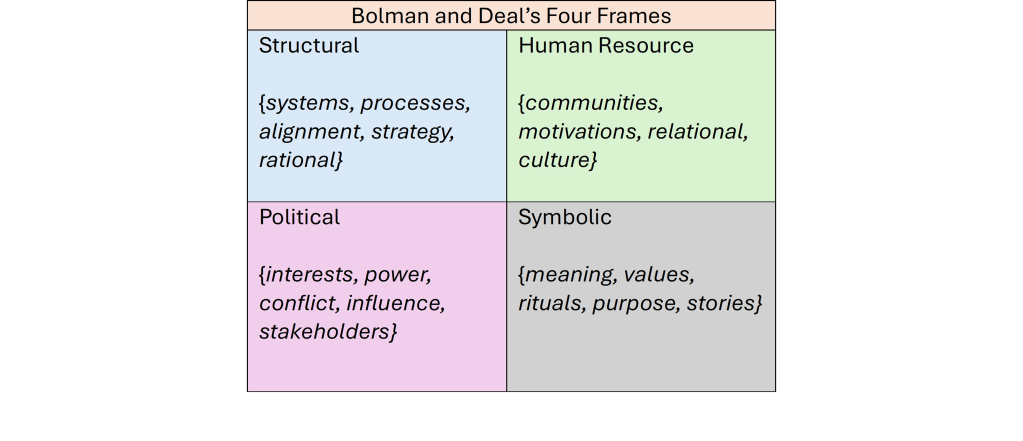
In Reframing Organizations, Bolman and Deal view organizations from four frames – structural, human resource, political, and symbolic. While these frames are useful tools, they’re most powerful when wielded by a manager who has the ability to identify more than one solution to a problem. Bolman and Deal note that, “those who master the ability to reframe report a liberating sense of choice and power. Managers are imprisoned only to the extent that their palette of ideas is impoverished (p. 17). “ Team leadership, composed of individuals with different perspectives, improves frame shifting.
“Shared leadership is a relational phenomenon whereby leadership and influence are distributed and reciprocated (Barnett & Weidenfeller, p. 341).” The creation of a team-based culture begins by actually valuing it and expecting that it be demonstrated. Creation of team consciousness means breaking habits, and “learning to embody leadership [as] a process of consciously aligning purpose with presence (Brendel & Bennett, p. 410.).” As noted by Barnett and Weidenfeller, shared leadership requires a number of preconditions. Members of the team must value and trust each other. A shared commitment to collaborative leadership means willingly ceding responsibility to others, whether the team leader or peers. The team has to be able to open with one another with concern for team cohesion. Understanding, common goals, and active coordination should be coupled to good communication, including “established norms for good discussion, constructive interaction, emotional self-control, and conflict resolution (p. 345).
At WVC, instructional deans meet every week at the “InstructionTeam” to ensure that this critical combination of purpose and presence reinforces a collective mindset. Importantly, instructional administrators at WVC are also assigned to lead a collegewide initiative in order to create experience driven leadership development. The expectation is that the administrators will develop additional leadership capacity by facilitating collaboratively with each other on a specific initiative, such as ConexEd, Collaborative Oversight, Advising Models, Enrollment Growth, Accessibility, Pathways work, and other initiatives.
Team Leadership requires sacrifices for a greater good. The team leader willingly delegates power and control in the name of capacity building. The team norms, reaches consensus, and then codifies what is agreed upon as an administrative practice. “Norm and codify” may be less efficient than a top down approach (“codify and deploy”), but I submit such an approach is generally more effective in higher education. Delegation has its challenges: the designee may lack the social capital, tools, clarity of purpose, or focus to carry out the task at first. Over time, however, the designee learns. In a team leadership model, the designee shares…and the team grows.
Effective team leadership is a continuous process of adaptation to and with each other. Interconnectedness, interdependency, and capacity — that is our continuing opportunity.
References:
Barnett, R. C. & Weidenfeller, N. K. (2016). Shared leadership and team performance Advances in Developing Human Resources, 18(3), 334-351.
Brendel, W. & Bennett, C. (2016). Learning to embody leadership through mindfulness and somatics practice. Advances in Developing Human Resources, 18(3), 409-425.
Bolman, L. G. & Deal, T. E. (2003). Reframing Organizations. (3rd Ed.) San Francisco, CA: Jossey-Bass.
Schein, E. H. (2010). Organizational culture and leadership. San Francisco, CA: Jossey-Bass.


Leave a comment