By Tod Treat
Blogger’s Note: I originally produced this document in an effort to convince my science colleagues of the validity of the use of online delivery for learning knowledge and skills related to laboratory work. Over a two decades have passed since it’s first publication, the framework by Domin is still a useful way to design labs, whether online, field based, or in a traditional science teaching lab. (First published in 2011).
Before discussing online labs specifically, it is important to consider the purposes of labs: what are they intended to do. Categorization of laboratory instruction reveals four basic types: expository, inquiry, discovery, and problem-based. These types can be contrasted based on the desired outcome, the pedagogical approach, and the experimental procedure (Table 1). All but two of our current experiments in general chemistry would be categorized as expository. Expository labs have been criticized for the lack of time students are given to reflect on the experiment and the emphasis on lower order cognitive skills according to Bloom’s taxonomy. Research indicates that students may come away with greater understanding when inquiry, discovery, and problem-based laboratories experiments are used (Domin, 1999).
Table 1: Laboratory Instuction Styles (Domin, 1999)
| Style | Outcome | Approach | Procedure |
| Expository | Predetermined | Deductive | Given |
| Inquiry | Undetermined | Inductive | Student generated |
| Discovery | Predetermined | Inductive | Given |
| Problem-based | Predetermined | Deductive | Student generated |
Another aspect of successful implementation of online labs involves a philosophical underpinning. Bodner (1986) describes science as a constructivist activity. Science requires us to build hypotheses based on what we already know (or think we know). Scientific knowledge is constructed among communities of experimenters. Kuhn (1970) has stated that
Science is not just a collection of laws, a catalog of unrelated facts. It is a creation of the human mind, with its freely invented ideas and concepts. The only justification for our mental structures is whether and in what way our theories form a link with the world of sense impression.
In a constructivist view of education, the learning of science should be more like the doing of science. Students should be engaged in inquiry and learn to formulate questions. They should learn to connect what they see in experiments to what they think or know about the world. Our job as teachers would then consist of guiding the modes of inquiry, teaching the skills needed to engage in inquiry, and correcting the misconceptions that so often are uncovered as students attempt to connect scientific concepts to their existing perceptions of the world. Often, this model is not followed because knowledge generation comes from the instructor, not the student. Allowing the student to process observations and data and work with it, as shown below, will go further towards helping students integrate it into their own processes.
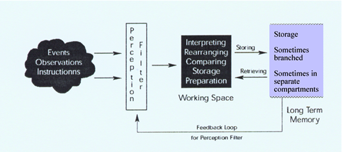
Figure 1: Information processing model (from Johnstone, A.H. 1997, 74, 262-268).
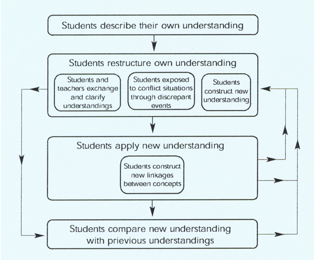
In this view of education, our traditional modes of instruction are sorely inadequate in both lecture and lab. The growth of problem-based learning, inquiry labs, discovery labs, and independent projects, however, hints that we may be adopting more constructivist axioms. For example, the Figure below showing a social constructivist model can be adapted to an inquiry model for laboratory experiments.
Choosing the appropriate solution first requires that you predetermine the type of lab, the equipment necessary, and the outcomes expected. Labs in which mastery of scientific equipment is an outcome usually require attendance on campus. However, simulations, labs modified for home use, kits, museum trips, and internet labs can all substitute effectively for particular kinds of labs. Can poker chips, playing cards, or other household items be used in place of animals in a predator-prey lab? Is a stick figure in a multimedia CD able to transmit the concepts? Can the student use household materials? Such questions require thought about the degree of realism needed and the fidelity and bandwidth available.
“One of the common problems with laboratory work is that the students are expected to simultaneously understand the conceptual background of the exercise as well as master the physical skills needed to accomplish the experiment. The conceptual material may include not only a theoretical framework – why does an acid-base titration give this shape curve – but also the laboratory concepts – what are the criteria for choosing the best indicator, etc. On the physical level, students must master skills such as adding one drop at a time in a titration or rinsing out a thin column of glass that is a meter long….Simulations allow the student to focus on a single type of learning” (Pence, 1997).
“At this time, available simulations cannot replicate the physical experiences that students would encounter in the laboratory, although virtual reality programs may soon offer a possibility of accomplishing this. Simulations do allow the student to focus on the conceptual background without the distraction of physical manipulations. In some cases this can be quite beneficial. Using a simulation as a pre-lab preparation alfows students to go into the laboratory with a better understanding ofwhat they will be doing. Laboratory simulations do not provide a replacement for laboratory, but at least they may improve one aspect ofchemistry teaching that is far from perfect” (Pence, 1997).
Online courses should be designed in a constructivist “shell” containing:
- Authentic context by connecting to everyday life.
- Authentic activities.
- Examples of “best practice,” such as a well-formulated hypothesis or experimental design.
- Multiple perspectives.
- Reflection.
- Collaboration.
- Coaching and scaffolding (use of decreasing instructor support as students become more capable).
- Use of authentic assessments. (Herrington, 2000)
The actual design of a constructivist unit should include the following (Crowther, 1999):
- an inquiry-based lab or authentic activity,
- done in groups,
- assessed at higher levels, such as ability to synthesize, problem-solve, interpret, etc.
- followed by lecture/discussion.
The unit should incorporate a conceptual framework and advance organizers, but should allow for various learning styles, and allow the students to make predictions, explore phenomenon, and evaluate theories (Leonard, 2000).
In practice, several institutions have developed routes for offering laboratories experiments in online formats. Usually, these include a mix of simulations/internet activities and “hands-on” experiments, either performed at home or on campus. (See appendices). Research exists to show that these setups are comparable, when their outcomes are compared, to similar on-campus offerings (Treat, 2000).
References:
Crowther, D. T. (1999) Cooperating with constructivism. Journal of College Science Teaching 29(1): 17-23.
Domin, Daniel S., (1999) “A Review of Laboratory Instruction Styles.” J. Chem. Ed. 76: 543-547.
Herrington J. & Standen, P. (2000) Moving from an instructivist to a constructivist multimedia learning environment. Journal of Educational Multimedia and Hypermedia 9(3): 195-205.
Leonard, W. H. (2000) How do college students learn best? Journal of College Science Teaching 29(6): 385-389.
Pence, H.E. (1997) “Are simulations just a substitute for reality?” Chem Conf ’97, http://webserver1.oneonta.edu/faculty/penche/paper9CC97.html
Treat, T.E. (2000) “Assessing and comparing outcomes in a lab-based science course delivered traditionally and online.” Presented at ICCFA Conference 2000. http://virtual.parkland.cc.il.us/todtreat/presentations/ICCFANov00.htm


Leave a Reply